




 £175.00
 £3,158.00
 £1,138.00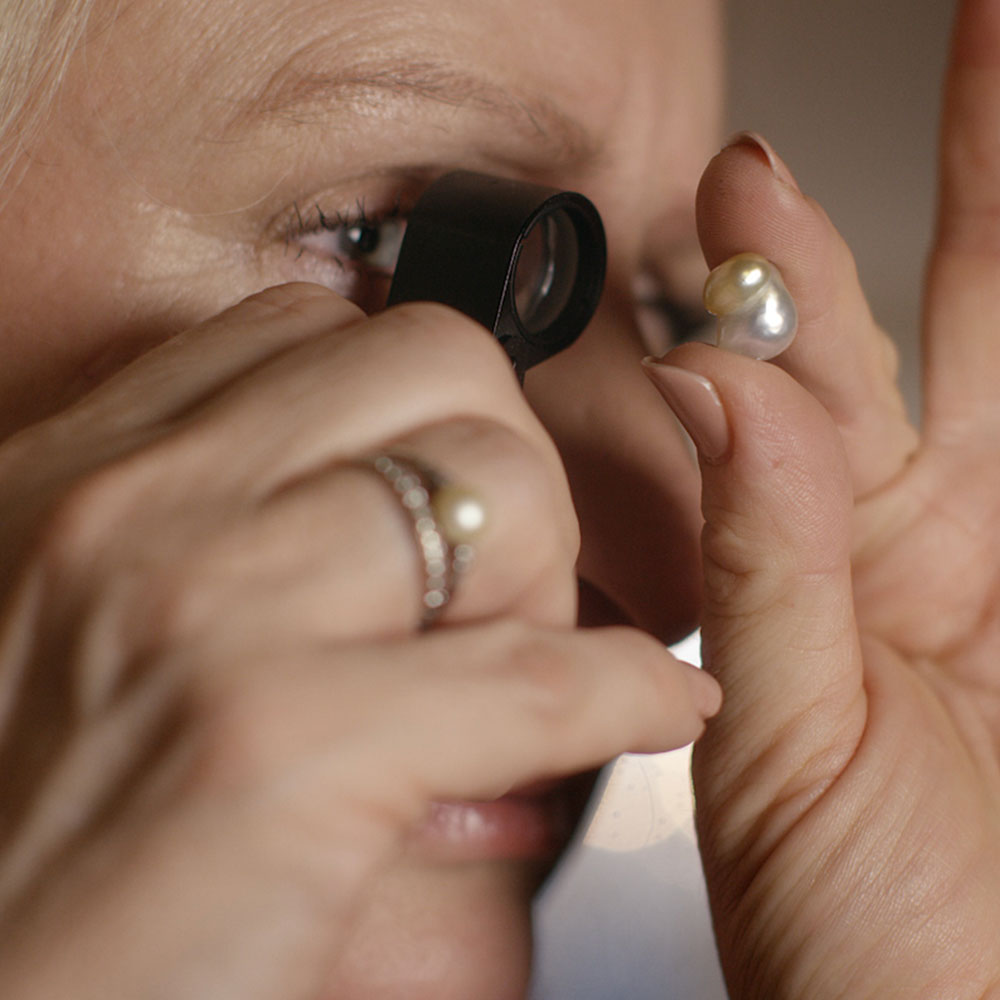



Are my pearls real?
There is no substitute for an expert eye, but there are six checks you can do at home, right now, to tell real pearls from fake. Answer honestly and we'll give you an authenticity score.
The checker above gives you a quick read on your pearls. This section explains what each test is actually looking for, so you understand the reasoning rather than just the result. After more than thirty years working with pearls, we can tell you that no single test is the whole answer. Real pearls give themselves away across several small signs at once, and that is exactly what the six checks are designed to pick up.
A quick word on what "real" means, because it trips people up. A real pearl is one grown inside a living mollusc, layer by layer, from nacre. That covers both natural pearls, which form on their own and are extraordinarily rare, and cultured pearls, which are farmed by gently introducing a nucleus and then letting the oyster do the rest over months or years. Both are genuine. A fake, or imitation, pearl is a bead of glass, plastic or shell that has been coated to look the part. It never grew inside anything. Everything below comes back to that one difference.
Take two pearls and rub them gently against each other. A real pearl feels faintly gritty, a little like very fine sandpaper. A fake slides smoothly, the way two glass beads or two plastic buttons would.
The reason is the nacre. Genuine nacre is built from microscopic plates of aragonite laid down in overlapping layers, and that crystalline structure creates the tiny friction you feel. An imitation is moulded smooth and then coated, so there is nothing for your fingertips to catch on. This is the same principle behind the old tooth test, where people rub a pearl against the biting edge of a tooth, but rubbing two pearls together is kinder to your pearls, more hygienic and just as telling.
One honest caveat. Some higher grade imitations are now made with a textured coating designed to mimic that grittiness, so a gritty feel is a good sign but not proof on its own. The reverse can also be true. In some countries genuine pearls are polished to give them a shinier lustre, and that polishing can smooth away the very grittiness you are feeling for. So a smooth finish does not always mean a fake. This is exactly why we never rest the whole judgement on one check.
Pick your pearls up after they have been sitting undisturbed for a while, and notice how they feel in the first second or two. Real pearls feel cool to the touch at first, then slowly warm against your skin as you hold them. A plastic imitation tends to feel neutral straight away, already at room temperature, with none of that initial coolness.
Nacre draws heat slowly, so a genuine pearl behaves a bit like marble or stone when you first touch it. The catch is that glass based fakes can also feel cool, because glass shares that quality. So this test is excellent at catching plastic imitations and less reliable against glass ones. Useful, but again, one piece of the picture.
Look closely at the surface, ideally with the magnifier on your phone camera. Two things are worth hunting for.
The first is a swirl pattern near the drill hole. As a pearl grows, nacre builds up in fine concentric layers, sometimes producing slight swirls or blemishes on the surface. A driller often chooses one of these marks as the spot to drill through, so a little natural swirl around the hole can be a good sign. An imitation works the other way round. If fake pearls are strung and then dipped in coating, whether that is a fish scale mixture or acrylic paint, the coating gathers around the thread and dries as a swirl or a series of rings against it. So on a coated fake you tend to see a paint like edge or a tight ring of coating built up around the hole.
The second is imperfection. Nature almost never makes two pearls identical. Real pearls carry small ridges, faint bumps, slight differences in shape from one to the next along a strand. If every pearl is flawless and perfectly matched, that uniformity is itself a warning sign, because it points to beads made by machine rather than grown by an oyster. This is why a strand that looks a little characterful is often more reassuring than one that looks suspiciously perfect.
Hold a pearl up to the light and look at the quality of its glow. What you are judging is lustre, which is the light that seems to come from within the pearl rather than a shine sitting flat on the surface.
Here is where we would gently correct a common myth. People often expect a real pearl to throw back a sharp, mirror like reflection. In truth, that mirror effect belongs only to exceptional pearls, and those are rare. A soft, deep glow that appears to sit just under the surface is completely genuine and is what most real pearls show. What gives an imitation away is not a lack of mirror sharpness, it is a flat, chalky sheen with no depth to it, the look of light bouncing off paint. So a soft inner glow is a good sign, a flat surface shine is not, and a true mirror finish simply tells you the pearl is a fine one.
Weigh the pearls in your hand and judge the heft against their size. Real pearls and their solid nacre are dense, so they tend to feel a little heavier than you expect. Many plastic imitations feel unexpectedly light, almost hollow.
As with temperature, glass fakes complicate things, since glass can feel satisfyingly weighty too. Some imitations are made from resin, a type of plastic that can be weighted to feel heavier than you would expect, so heft alone will not rule a fake out. Weight is best treated as a supporting clue rather than a deciding one. If a supposedly substantial strand feels flimsy and insubstantial, that tells you something. If it feels solid, that is mildly reassuring but not conclusive.
If the pearls are strung, the drilled hole is one of the most revealing places to look, because it shows you a cross section of the pearl. Examine the edge of the hole closely under magnification.
On a real pearl you are looking for clean, sharp edges and, ideally, a visible layer of nacre wrapped over a bead centre. On many cultured pearls that nacre layer is roughly ten to twenty per cent of the pearl’s diameter, and you can sometimes make out its fine layered rings. On an imitation, the coating tends to give itself away at the hole, either by showing the swirl of coating described in check three, or by flaking and peeling back like chipped nail varnish, or appearing as a thin painted ring over a glass or plastic core.
If your pearls are knotted between each bead, set in metal, or you simply cannot get a clear view of the hole, that is fine. It just means this particular check sits out, and the other five carry the verdict.
Put all six together and you get a genuinely useful read, which is what the score above is built to give you. But we would be doing you a disservice if we pretended these tests were the final word. They are not, and no reputable pearl specialist would claim otherwise.
The things that separate a good pearl from a great one, and a clever fake from the real thing, often need a trained eye and, in some cases, laboratory testing. Nacre thickness, whether a pearl has been treated or dyed, its true origin and type, the difference between a natural and a cultured pearl, these are judgements built on years of handling thousands of pearls. It is the same expertise that goes into matching a pearl’s colour and shape to the person wearing it, which has been at the heart of what we do at Coleman Douglas Pearls since 1989.
So treat the checker as a confident first opinion, not a certificate. If it points towards real, wonderful. If it leaves you unsure, or if you are thinking about buying pearls you want to trust for a lifetime, that is exactly the moment to talk to a specialist.
Chrissie and the team have spent over thirty years matching people with pearls they will treasure, sourced directly from farmers we know by name. If you would like a hand choosing, we are here.
A consultation carries a small fee, and that fee comes straight off the price of anything you go on to buy, so it is credited back to you against your purchase. Choose the option that suits you below.